
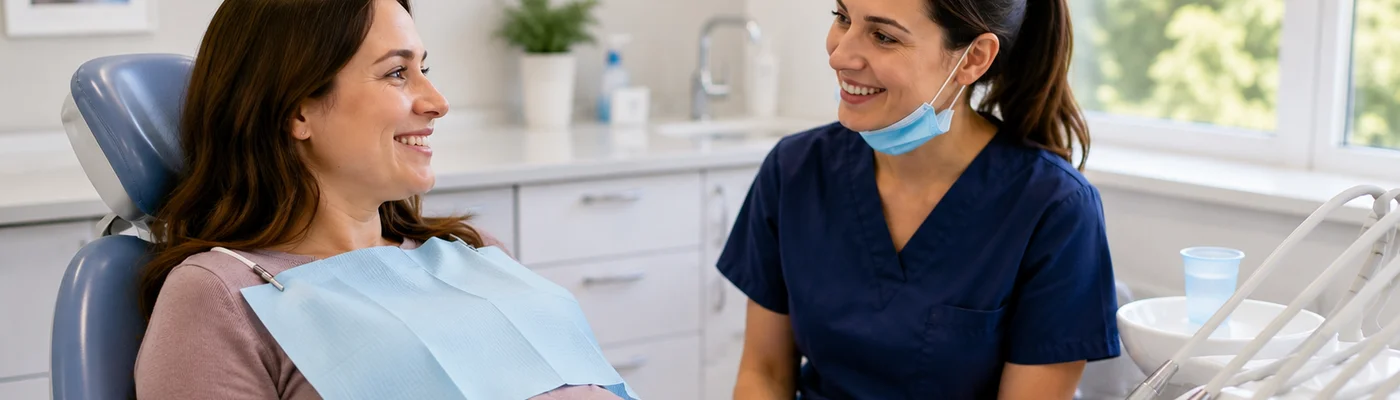
If you are pregnant, you may be entitled to free NHS or Health Service dental treatment during your pregnancy and for up to 12 months after your baby is born.
This support applies to treatment provided through the public dental system. Private dental treatment remains chargeable, even during pregnancy, so it is important to confirm whether your appointment and proposed treatment are being provided on an NHS or private basis.
Regular dental care can be particularly helpful during pregnancy because hormonal changes may make the gums more sensitive to plaque, increasing the likelihood of inflammation, swelling and bleeding.
Glow Dental provides advice and treatment for patients who need dental care during pregnancy.
Is NHS Dental Treatment Free During Pregnancy?
Yes. You can receive free NHS or Health Service dental treatment while you are pregnant and for 12 months after giving birth, provided the care is supplied through the relevant public dental system.
The exemption applies when the course of treatment begins while you are pregnant or within the qualifying period after your baby is born.
The exact rules and evidence requirements vary slightly between England, Scotland, Wales and Northern Ireland. Your dental practice, midwife or GP can advise which document you need.
How Do You Prove That You Are Eligible?
You may be asked to provide evidence that you are pregnant or that you gave birth within the previous 12 months.
Depending on where you live, accepted evidence may include:
- A maternity exemption certificate
- A maternity certificate such as a MATB1
- A maternity form issued by a doctor or midwife
- A notification of birth
- Your baby’s birth certificate
- Other evidence accepted by the relevant NHS or Health Service authority
In England, a maternity exemption certificate is commonly used as proof of entitlement. Different forms may be used in Scotland, Wales and Northern Ireland.
Tell the dental practice that you are pregnant when arranging your appointment and bring any requested evidence with you.
What Dental Treatment Is Free During Pregnancy?
Clinically necessary treatment provided through the NHS or Health Service should be covered by the pregnancy exemption.
This may include:
- Routine dental examinations
- Necessary dental X-rays
- Preventive advice and treatment
- Dental fillings
- Treatment for gum disease
- Root canal treatment
- Tooth extractions
- Treatment for pain or dental infection
- Clinically necessary emergency dental care
A dental examination allows the dentist to assess your teeth and gums and identify any treatment that may be required.
Where decay is present, treatment could include a dental filling. More extensive infection inside a tooth may require root canal treatment.
The treatment must be clinically necessary. The exemption does not give an automatic right to every possible dental procedure or to a particular cosmetic treatment option.
Are Dental X-Rays Free and Safe During Pregnancy?
If a dental X-ray is clinically necessary and is being provided as part of NHS or Health Service treatment, it may be included within your free care.
Always tell your dentist that you are pregnant. The dental team will consider whether the X-ray is needed, whether it can be postponed and what precautions are appropriate.
A necessary X-ray should not be confused with routine imaging carried out without a clinical reason. The decision should be based on your individual symptoms and treatment needs.
Can You Have Local Anaesthetic During Pregnancy?
Local anaesthetic may be used for dental treatment during pregnancy where the dentist considers it appropriate.
The dentist should review:
- How many weeks pregnant you are
- Your general health and medical history
- Any medicines you currently take
- The urgency and complexity of the dental treatment
- Any advice provided by your GP, midwife or obstetric team
Do not assume that necessary dental treatment must always be delayed until after the pregnancy. Untreated pain or infection may require prompt attention. Your dentist will discuss the safest and most appropriate treatment plan for your circumstances.
What Is Not Covered by Free NHS Dental Care?
Treatment carried out purely for cosmetic reasons is not normally included within free NHS or Health Service dental care.
Examples may include:
- Elective teeth whitening
- Veneers requested only to change the appearance of the teeth
- Cosmetic bonding carried out solely for aesthetic improvement
- Other optional private upgrades
Procedures such as teeth whitening, porcelain veneers and composite bonding are generally provided privately where they are requested for cosmetic reasons.
However, similar restorative treatment may sometimes be clinically necessary. Your dentist should explain whether the recommended procedure is available through the NHS or must be provided privately.
Why Can Pregnancy Affect the Teeth and Gums?
Hormonal changes during pregnancy can alter how the gums respond to plaque. The gums may become:
- Red or inflamed
- Swollen or tender
- More likely to bleed during brushing or flossing
This does not mean that bleeding gums should be ignored. Persistent inflammation may require professional advice and improved plaque control.
Morning sickness, changes in diet and difficulty maintaining normal brushing routines may also affect oral health during pregnancy.
Professional cleaning and preventive advice from a dental hygienist may help manage plaque and support healthier gums. Confirm whether any hygienist treatment is being provided through the NHS or privately before the appointment.
How to Look After Your Teeth During Pregnancy
You can help protect your teeth and gums by:
- Brushing twice a day with fluoride toothpaste
- Cleaning between the teeth where advised
- Spitting after brushing rather than rinsing immediately
- Limiting frequent sugary snacks and drinks
- Attending dental appointments at the recommended intervals
- Seeking advice if the gums remain swollen or bleed frequently
- Telling the dentist about your pregnancy and any medicines you take
If morning sickness causes vomiting, avoid brushing immediately afterwards. Rinsing the mouth gently with water first can help avoid brushing acid against the tooth surface.
When Should You Contact a Dentist Urgently?
Contact a dentist promptly if you experience:
- Severe or persistent toothache
- Swelling of the gum, face or jaw
- Signs of a dental infection
- A broken or damaged tooth
- Persistent bleeding from the mouth
- Difficulty eating because of dental pain
- A dental injury
Do not wait until after the pregnancy to seek help for severe pain, swelling or infection. Glow Dental offers emergency dental treatment for patients who require urgent assessment.
NHS and Private Dental Care During Pregnancy
The pregnancy exemption applies only to NHS or Health Service treatment. It does not require a private dental practice to provide all treatment without charge.
Before booking, ask:
- Whether the practice is accepting NHS patients
- Whether your appointment will be NHS or private
- Whether the proposed treatment is clinically necessary
- Whether any private options or additional fees will apply
- What evidence of maternity exemption you need to bring
Some patients choose private dental care because they want greater appointment availability, longer appointments or access to treatment options that are not available through the NHS.
Glow Dental’s current private treatment prices are available in our dental fee guide.
Can You Claim a Refund If You Have Already Paid?
You may be able to claim a refund where you paid an NHS dental charge but were eligible for free treatment at the relevant time.
Refund rules and deadlines apply, so keep your receipt and contact the appropriate NHS or Health Service authority promptly. A refund would not normally apply to treatment that was agreed and provided privately.
Key Points About Dental Treatment During Pregnancy
- NHS or Health Service dental treatment is free during pregnancy and for 12 months after giving birth.
- The exemption applies to public dental treatment, not automatically to private care.
- You may need to provide a maternity certificate or other proof of eligibility.
- Clinically necessary examinations, fillings, extractions and other treatment may be covered.
- Treatment carried out purely for cosmetic reasons is not normally included.
- Always tell your dentist that you are pregnant.
- Seek prompt advice for severe pain, swelling or signs of infection.
Dental Care During Pregnancy at Glow Dental
Our dental team can assess concerns involving your teeth and gums during pregnancy and explain which treatment options are appropriate.
Learn more about visiting the dentist while pregnant or arrange an appointment at our Battersea dental practice.
Written by:
Glow Dental
Published:
Last updated: