
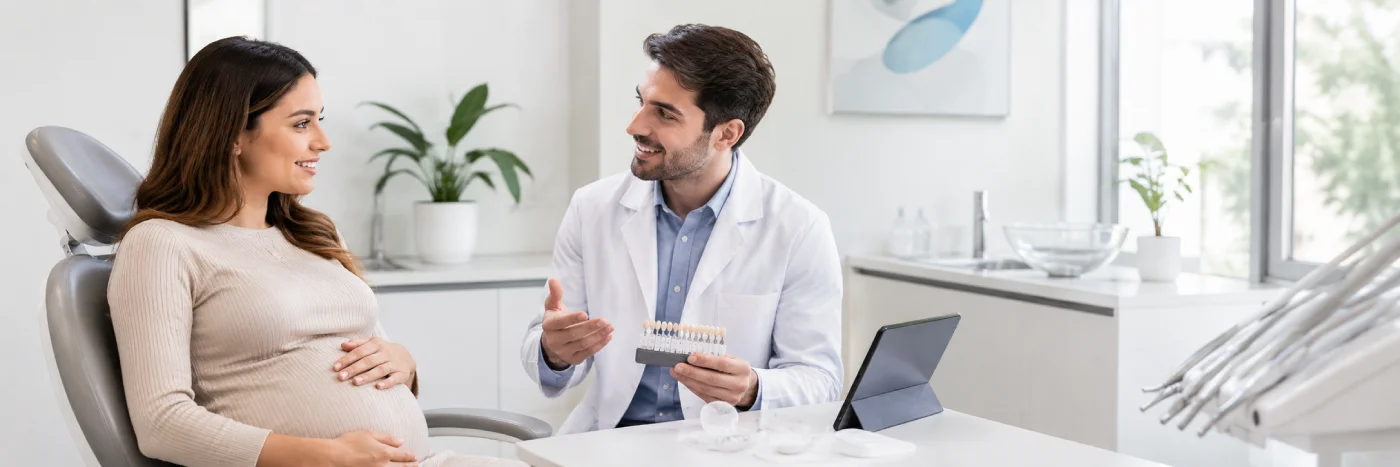
Teeth whitening is an elective cosmetic dental treatment used to lighten the colour of natural teeth. Current NHS guidance does not recommend teeth whitening during pregnancy or while breastfeeding.
This does not mean that whitening has been proven to harm a developing baby. The recommendation is precautionary: there is limited clinical evidence about cosmetic bleaching during pregnancy and breastfeeding, and whitening can normally be postponed without affecting dental health.
Pregnancy can also make the gums more prone to inflammation and bleeding, while whitening itself can temporarily cause tooth sensitivity and gum irritation. For these reasons, it is generally more appropriate to concentrate on maintaining healthy teeth and gums during pregnancy and consider cosmetic whitening afterwards.
Can You Whiten Your Teeth While Pregnant? The Short Answer
Teeth whitening should be postponed during pregnancy. NHS guidance also advises against whitening while breastfeeding.
This includes dentist-supervised home whitening, whitening carried out at a dental practice and bleaching gels or strips used independently at home.
The advice applies throughout pregnancy rather than only during the first trimester. There is no established trimester in which elective tooth bleaching becomes routinely recommended.
However, pregnancy is not a reason to avoid necessary dental care. Routine dental examinations, hygiene care and treatment for pain, decay, gum problems or infection should still be carried out when clinically required.
Why Is Teeth Whitening Not Recommended During Pregnancy?
The main reason is the lack of sufficient clinical evidence specifically assessing cosmetic tooth whitening during pregnancy.
Most professional whitening systems use hydrogen peroxide or carbamide peroxide, which releases hydrogen peroxide. Peroxide molecules pass through the enamel and dentine and chemically alter coloured molecules within the tooth, making the natural tooth appear lighter.
Whitening is widely used in non-pregnant adults and is generally considered safe for suitable patients when correctly prescribed and supervised. Pregnancy is different because unnecessary exposure to an elective cosmetic treatment can simply be avoided until later.
The recommendation should therefore be understood as precautionary rather than evidence that professional whitening causes birth defects or pregnancy complications.
Is There Evidence That Teeth Whitening Harms an Unborn Baby?
There is currently insufficient human clinical evidence to confidently determine the safety of cosmetic tooth bleaching during pregnancy.
This is different from evidence proving that whitening is dangerous. Pregnant patients are rarely included in clinical trials of elective cosmetic treatments, so high-quality pregnancy-specific safety data are naturally limited.
Because whitening can easily be delayed, professional guidance takes the cautious approach of recommending that treatment wait until pregnancy has finished.
Can You Have Professional Teeth Whitening While Pregnant?
Professional teeth whitening should normally be postponed until after pregnancy and breastfeeding.
This applies even though dentist-supervised whitening is generally the safest route when whitening is otherwise appropriate. A professional dental assessment does not remove the lack of pregnancy-specific evidence.
Before providing professional teeth whitening, a dentist should assess whether the teeth and gums are healthy and whether whitening is likely to produce an appropriate result.
Issues such as untreated decay, gum disease, cracked teeth, significant sensitivity and visible restorations may need to be considered before whitening begins.
What About Dentist-Prescribed Home Whitening Trays?
Custom-made whitening trays supplied by a dentist are still a form of cosmetic tooth bleaching and should therefore be postponed during pregnancy and breastfeeding.
The fact that treatment takes place at home rather than in the dental surgery does not change this recommendation.
Once pregnancy and breastfeeding have finished, custom-made trays can be an effective way of whitening natural teeth because the dentist can assess suitability, prescribe the appropriate gel and monitor sensitivity and gum irritation.
Can You Use Whitening Strips During Pregnancy?
Whitening strips should also be postponed during pregnancy and breastfeeding.
Many strips use peroxide or another bleaching chemistry to change the colour of natural teeth. Products bought online can also vary considerably in formulation, strength, quality and instructions.
In addition to the pregnancy issue, strips can cause temporary tooth sensitivity and gum irritation when whitening material repeatedly contacts the gingiva.
Read more about the evidence, UK rules and potential side effects in our guide: Are teeth whitening strips safe?
Are Peroxide-Free Whitening Products Safe During Pregnancy?
A product being described as “peroxide-free”, “natural”, “PAP-based” or “sensitive” does not automatically make it suitable for pregnancy.
There is considerably less clinical evidence for some newer peroxide-free bleaching ingredients than there is for established peroxide whitening systems, and pregnancy-specific evidence is particularly limited.
It is therefore sensible to postpone products designed to chemically bleach the teeth, regardless of whether their marketing emphasises that they contain no peroxide.
Can You Use Home Whitening Kits While Pregnant?
Home bleaching kits bought from pharmacies, beauty retailers, social-media sellers or online marketplaces should not be used during pregnancy.
Products purchased without a dental assessment can also create other problems because they may:
- Fit poorly around the teeth and gums
- Allow whitening material to contact soft tissues
- Increase tooth sensitivity
- Be used on untreated cavities or cracked teeth
- Produce uneven whitening
- Contain ingredients or concentrations that are unclear
When whitening is appropriate after pregnancy, having the teeth assessed professionally first reduces the risk of treating teeth that are unsuitable for bleaching.
What Are the UK Rules on Teeth Whitening?
In the UK, tooth whitening is considered a dental treatment and should only be provided by appropriately registered dental professionals.
Products containing or releasing between 0.1% and 6% hydrogen peroxide are subject to the professional dental pathway. An appropriate dental examination should take place before treatment, and the first use in each treatment cycle must be by a dentist or under appropriate direct supervision.
Cosmetic whitening products releasing more than 6% hydrogen peroxide are not permitted for routine cosmetic tooth whitening.
This is relevant after pregnancy too: having whitening offered by a beautician or other unregistered provider is not made legal simply because the provider describes the product as peroxide-free.
Can You Use Whitening Toothpaste During Pregnancy?
A normal fluoride toothpaste should continue to be used during pregnancy. Brush twice daily for approximately two minutes, including last thing at night, and spit out excess toothpaste rather than immediately rinsing with water.
Many products labelled as whitening toothpaste do not bleach the internal colour of the teeth. Instead, they contain cleaning or polishing ingredients that can help remove some external surface staining.
This makes whitening toothpaste different from peroxide bleaching gels and trays.
However, repeatedly using highly abrasive products in an attempt to scrub teeth whiter is not advisable, particularly if you already have sensitive teeth, gum recession or dental erosion.
Our complete toothpaste guide explains fluoride, whitening and sensitivity toothpastes in more detail.
Can You Have a Dental Hygiene Appointment While Pregnant?
Yes. Professional dental hygiene care can be particularly useful during pregnancy if plaque, calculus, bleeding gums or surface staining are present.
A hygiene appointment is different from teeth whitening. Professional cleaning can remove plaque, calculus and some external staining from substances such as tea or coffee, but it does not chemically bleach the natural internal colour of the tooth.
If your main concern is staining rather than the underlying shade of your teeth, professional cleaning may therefore improve their appearance without bleaching.
Read more about the distinction in our guide to which tooth stains whitening can remove.
Why Can Pregnancy Make Your Gums Bleed?
Hormonal changes during pregnancy can alter the way gingival tissues respond to dental plaque. As a result, some pregnant patients develop more noticeable gum inflammation, swelling and bleeding.
This is commonly referred to as pregnancy gingivitis.
Possible symptoms include:
- Bleeding when brushing
- Bleeding during interdental cleaning
- Red or swollen gums
- Gum tenderness
- Increased plaque around the gumline
- Bad breath in some cases
Pregnancy itself does not make gum inflammation inevitable. Effective plaque removal remains extremely important.
If your gums regularly bleed, do not stop brushing them. Arrange an assessment so your dentist or hygienist can determine whether plaque-induced gingivitis or another periodontal problem is present.
Find out more about looking after your teeth and gums during pregnancy.
Does Whitening Cause More Sensitivity During Pregnancy?
There is not enough evidence to say that pregnancy itself necessarily makes whitening sensitivity worse.
However, temporary tooth sensitivity is one of the most common side effects of peroxide whitening, even outside pregnancy. Whitening material can diffuse through enamel and dentine and temporarily affect the pulp-dentine complex.
Because there is no need to introduce this additional discomfort during pregnancy for a purely cosmetic benefit, postponing treatment is sensible.
Read more about sensitive teeth during whitening and whether teeth whitening can damage teeth.
Can You Whiten Your Teeth While Breastfeeding?
NHS guidance also does not recommend cosmetic teeth whitening while breastfeeding.
Again, the recommendation is precautionary because good-quality evidence specifically examining cosmetic bleaching during breastfeeding is limited.
There is no need to speculate about whether tiny quantities of a particular whitening product enter breast milk or what concentration would theoretically be safe. Whitening is elective and can simply be postponed until breastfeeding has finished.
What If You Used Teeth Whitening Before Realising You Were Pregnant?
If you used a whitening product before discovering that you were pregnant, do not assume that you have harmed your baby.
The recommendation to avoid whitening is based primarily on insufficient pregnancy-specific evidence and the fact that treatment is optional, not on evidence that brief accidental whitening exposure causes pregnancy complications.
Stop further bleaching applications once you know you are pregnant. If you are worried about a product you used, particularly if the ingredients or concentration are unclear, tell your dentist, midwife or doctor.
There is no reason to continue a whitening course simply because you have already completed some applications.
Is Dental Treatment Safe During Pregnancy?
Necessary dental treatment should not be confused with elective cosmetic whitening.
Pregnant patients should continue to receive appropriate dental care. Toothache, dental infection, cavities, broken teeth and gum disease should not be left untreated simply because someone is pregnant.
Tell your dentist that you are pregnant or think you may be pregnant so treatment, medicines and any necessary investigations can be planned appropriately.
Glow Dental’s guide to seeing a dentist during pregnancy explains pregnancy-specific dental care in more detail.
Can You Have Dental X-Rays While Pregnant?
Dental X-rays may be taken during pregnancy when they are clinically necessary. Modern dental radiography involves very low radiation doses, and dentists should only take an X-ray where the expected diagnostic benefit justifies the exposure.
You should always tell the dental team that you are pregnant before treatment or imaging.
Unnecessary investigations can be postponed, but an X-ray that is genuinely needed to diagnose significant pain, infection or another dental problem should not automatically be avoided purely because of pregnancy.
Is NHS Dental Treatment Free During Pregnancy?
If you qualify for NHS dental care in England, necessary NHS dental treatment is free during pregnancy and for a qualifying period after your baby is born when you have the appropriate maternity exemption evidence.
This relates to NHS treatment. Cosmetic whitening is not NHS treatment and is normally provided privately.
Read our separate guide to what dental treatment is free when you are pregnant.
How Does Morning Sickness Affect Your Teeth?
Repeated vomiting exposes the teeth to stomach acid. This can temporarily soften the surface of the enamel and, if exposure is frequent, contribute to dental erosion.
After vomiting:
- Rinse your mouth thoroughly with water
- Do not brush your teeth immediately
- Wait approximately one hour before brushing
- Continue using fluoride toothpaste twice daily
- Consider an alcohol-free fluoride mouthwash at a different time from toothbrushing if advised
- Speak to your dentist if vomiting is frequent or your teeth become sensitive
Brushing immediately after repeated acid exposure can increase mechanical wear of temporarily softened enamel.
What If Morning Sickness Is Severe?
Frequent vomiting can increase the risk of dental erosion, but severe pregnancy sickness can also cause dehydration and other medical complications.
If you cannot keep food or fluids down, are becoming dehydrated or have severe persistent vomiting, contact your midwife, GP or maternity team rather than treating the problem as only a dental issue.
Your dentist can help manage any resulting sensitivity or erosion while your medical team manages the underlying pregnancy sickness.
How Can You Keep Your Teeth Looking Whiter During Pregnancy?
Although cosmetic bleaching should wait, there are several ways to maintain a clean and healthy-looking smile during pregnancy.
Brush Twice Daily With Fluoride Toothpaste
Brush carefully for around two minutes twice daily using fluoride toothpaste. Pay particular attention to the gumline, where pregnancy-associated inflammation can become more noticeable.
Clean Between Your Teeth Every Day
Use floss or appropriately sized interdental brushes to remove plaque from areas a normal toothbrush cannot reach.
Have Surface Staining Professionally Removed
A dental hygiene appointment can remove plaque, calculus and some external stains without chemically changing the internal shade of your teeth.
Reduce Frequent Staining Exposures
Tea and coffee can contribute to external staining. Rinsing with water after these drinks may help reduce prolonged contact with the teeth.
Do not make unnecessary dietary restrictions during pregnancy simply to avoid tooth staining.
Avoid Tobacco
Smoking can significantly stain teeth and also increases the risk of periodontal disease and other serious health problems. Pregnancy provides an especially important opportunity to seek smoking-cessation support if required.
Should You Try Natural Teeth Whitening During Pregnancy?
No. “Natural” does not mean harmless, and many popular DIY whitening methods either have little good evidence behind them or can damage the tooth surface.
Avoid attempting to whiten teeth with:
- Lemon juice
- Other acidic fruit mixtures
- Activated charcoal
- Undiluted baking soda
- Salt scrubs
- Household hydrogen peroxide
- Household bleaching products
Acidic ingredients can contribute to enamel erosion, while abrasive powders can increase tooth-surface wear.
What About Activated Charcoal Toothpaste?
Activated charcoal is widely promoted online for whitening, but evidence that charcoal products safely produce meaningful intrinsic tooth whitening is limited.
Some products rely largely on abrasive removal of external stain. Excessive abrasion is not desirable, particularly where enamel erosion, gum recession or exposed dentine are already present.
There is no reason to use charcoal during pregnancy as an alternative to professional bleaching.
Do Fillings, Crowns or Veneers Whiten?
No. Whitening changes the colour of natural dental tissues but does not predictably lighten most existing dental restorations.
This includes:
If restorations are visible when you smile, they should be considered when planning whitening after pregnancy because the natural teeth may become lighter while the restoration remains approximately the same colour.
Our guide to teeth whitening and composite bonding explains why the order of treatment can matter.
When Can You Start Whitening After Pregnancy?
Based on current NHS advice, cosmetic whitening can be considered after pregnancy and breastfeeding have finished.
There is no evidence-based rule requiring an additional waiting period of several months after breastfeeding ends. Once you are no longer pregnant or breastfeeding, your dentist can assess whether whitening is suitable.
The examination should consider:
- The health of your teeth and gums
- Any active tooth decay
- Existing sensitivity
- Cracks or significant tooth wear
- Gum recession and exposed roots
- The cause of the discolouration
- Fillings, crowns, veneers or bonding that will not whiten
- Your expectations for the final shade
Different types of discolouration respond differently, so read our guide to which stains teeth whitening can remove.
Can You Have a Whitening Consultation While Pregnant?
You can discuss future cosmetic treatment with your dentist during pregnancy, but there is usually little benefit in beginning active bleaching until pregnancy and breastfeeding are over.
The more immediate priority should be checking that the teeth and gums are healthy and managing any dental problems that cannot safely wait.
If you want to plan future whitening, your dentist can explain the available options and review treatment again when you are ready to begin.
Frequently Asked Questions About Teeth Whitening During Pregnancy
Is teeth whitening safe during the first trimester?
Current NHS advice does not recommend tooth whitening during pregnancy, and it does not provide an exception for the first, second or third trimester.
Can I whiten my teeth in the second trimester?
Cosmetic bleaching should still be postponed. Although the second trimester is often a convenient time for necessary dental care, this does not mean elective whitening becomes recommended.
Can I use whitening strips if they contain very little peroxide?
Whitening strips are still elective cosmetic products and should be postponed during pregnancy. Low peroxide concentration does not create evidence that a particular product is appropriate for use during pregnancy.
Can I use peroxide-free strips while pregnant?
They should also be postponed. Newer peroxide-free bleaching agents do not automatically have stronger pregnancy safety evidence than traditional peroxide products.
Can I use normal fluoride toothpaste while pregnant?
Yes. Fluoride toothpaste should continue to be used twice daily. It protects against tooth decay and is not the same as cosmetic bleaching treatment.
Can I use whitening toothpaste while pregnant?
Many whitening toothpastes primarily remove external stains rather than bleach the tooth. A normal fluoride toothpaste with modest stain-removing properties can generally form part of routine oral hygiene, but highly abrasive products should be avoided.
Can I have my teeth professionally cleaned while pregnant?
Yes. Dental hygiene care can be provided during pregnancy where appropriate and may be particularly helpful if pregnancy-associated gingivitis, plaque or calculus is present.
Can I have laser teeth whitening during pregnancy?
No form of cosmetic tooth whitening is currently recommended during pregnancy. Adding a light or laser does not overcome the lack of pregnancy-specific evidence.
Will pregnancy permanently make my teeth yellow?
Pregnancy itself does not necessarily permanently change tooth colour. Changes in diet, plaque accumulation, staining, morning-sickness erosion and oral-hygiene difficulties can alter the appearance of teeth, but the cause should be assessed individually.
What if I accidentally whitened my teeth while pregnant?
Stop further treatment, but do not assume harm has occurred. The recommendation to avoid whitening is precautionary rather than based on evidence that a brief exposure causes pregnancy complications.
Can I whiten my teeth while breastfeeding?
NHS guidance also recommends postponing teeth whitening while breastfeeding. Treatment can be reconsidered after breastfeeding has finished.
Dental Care During Pregnancy at Glow Dental
Glow Dental recommends postponing cosmetic teeth whitening during pregnancy and breastfeeding, but maintaining your oral health during pregnancy remains important.
Our team can help with:
- Dental examinations
- Assessment of bleeding or swollen gums
- Professional dental hygiene care
- Advice about fluoride toothpaste and interdental cleaning
- Treatment of tooth decay
- Urgent dental problems
- Assessment of tooth sensitivity and erosion
- Planning professional teeth whitening after pregnancy and breastfeeding
Find out more about dental care during pregnancy at Glow Dental.
Book a Dental Assessment at Glow Dental
Glow Dental is a private dental practice at 87 Northcote Road, Battersea, London SW11 6PL, close to Clapham Junction.
If you are pregnant and have bleeding gums, sensitivity, toothache, erosion from morning sickness or another dental concern, you do not need to wait until after pregnancy to have it assessed.
If you are new to the practice, find out more about becoming a new patient at Glow Dental or contact the practice to arrange an appointment.
Summary: Can You Whiten Your Teeth While Pregnant?
Current NHS guidance does not recommend cosmetic teeth whitening during pregnancy or breastfeeding. This is a precautionary recommendation because pregnancy-specific evidence is limited and whitening is an elective procedure that can normally be postponed without affecting oral health.
This applies to professional whitening, dentist-prescribed home trays, bleaching gels and whitening strips. Products marketed as peroxide-free or natural should not automatically be assumed to be suitable alternatives.
Routine dental care should continue during pregnancy. Dental examinations, hygiene care and necessary treatment for decay, gum disease, pain or infection remain important, while professional cleaning can help remove external staining without bleaching the natural colour of the teeth.
Once pregnancy and breastfeeding have finished, a dentist can assess the health of your teeth and gums and help you choose an appropriate professional whitening treatment.
Written by:
Glow Dental
Published:
Last updated: