
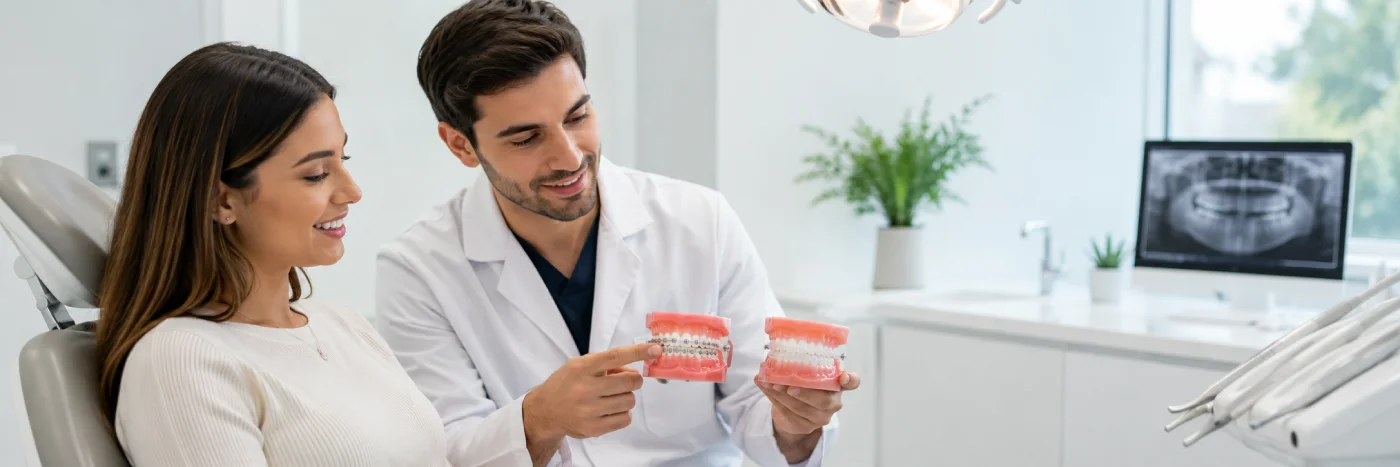
Metal braces and ceramic braces are both fixed orthodontic treatments used to straighten teeth and improve the bite. They work in a similar way, using brackets and wires to apply controlled pressure and gradually move the teeth into a better position.
The main difference is appearance. Metal braces use stainless steel brackets and are more visible, while ceramic braces use clear or tooth-coloured brackets that blend more naturally with the teeth.
Metal braces are not automatically better than ceramic braces. They are usually stronger, more durable and more cost-effective. Ceramic braces are more discreet, but they can be more fragile, may require greater care and are not suitable for every patient.
Metal Braces vs Ceramic Braces: The Short Answer
Metal braces may be the better choice if you want a strong, reliable and usually more affordable treatment, particularly if your orthodontic case is complex.
Ceramic braces may be the better choice if appearance during treatment is especially important and your teeth and bite are suitable for tooth-coloured brackets.
The right option depends on your bite, the movements required, your budget, your lifestyle and how visible you are comfortable with your braces being.
What Are Metal Braces?
Metal braces are the traditional type of fixed orthodontic appliance. Small stainless steel brackets are attached to the teeth and connected by an orthodontic wire. The wire is adjusted during treatment to guide the teeth towards their planned positions.
Metal braces are widely used because they are strong, predictable and suitable for many orthodontic concerns, including:
- Crowded teeth
- Gaps between teeth
- Rotated or tilted teeth
- Protruding teeth
- Overbites, underbites and crossbites
- More complex tooth movements
The brackets are visible, although patients can often choose coloured or more neutral elastic ties at their adjustment appointments.
What Are Ceramic Braces?
Ceramic braces work in a similar way to metal braces, but the brackets are made from clear or tooth-coloured ceramic material. This makes them less noticeable, particularly from a distance or in photographs.
They are often chosen by adults and older teenagers who want the control of a fixed brace but prefer a more discreet appearance.
Ceramic braces can treat many of the same orthodontic problems as metal braces. However, the brackets are more brittle than metal brackets and may not be recommended for every case or every part of the mouth.
Metal Braces vs Ceramic Braces Comparison
| Feature | Metal Braces | Ceramic Braces |
| Appearance | More visible | Clear or tooth-coloured and more discreet |
| Strength | Very strong and durable | Strong, but more brittle than metal |
| Cost | Usually the more affordable option | Usually more expensive |
| Complex treatment | Suitable for a wide range of cases | Suitable for many cases, but not always recommended for every complex movement |
| Lower teeth | Commonly used on upper and lower teeth | May not be suitable on lower teeth for patients with a deep bite |
| Discolouration | Metal brackets do not discolour | Clear or tooth-coloured ties may stain between appointments |
| Breakages | Less likely to chip or fracture | Requires more care because ceramic brackets can be more fragile |
| Personalisation | Coloured elastic ties may be available | Usually selected for a subtle, neutral appearance |
Advantages of Metal Braces
Metal braces remain one of the most widely used orthodontic treatments because they are durable and can provide precise control over tooth movement.
- They are suitable for many simple and complex orthodontic cases.
- Metal brackets are strong and resistant to chipping.
- They are usually less expensive than ceramic braces.
- They do not have clear ties that may become visibly stained.
- They can be used on both the upper and lower teeth in a wide range of bites.
- Patients may be able to personalise them with coloured elastic ties.
Disadvantages of Metal Braces
The main drawback of metal braces is their visibility. Some patients, particularly adults, may feel self-conscious about wearing an obvious fixed appliance.
- They are more noticeable than ceramic braces.
- Some patients dislike the metallic appearance.
- They can cause temporary soreness or rubbing after fitting and adjustments.
- Careful cleaning is needed around the brackets and wires.
Advantages of Ceramic Braces
The main benefit of ceramic braces is that they are more discreet. The brackets blend with the teeth, making the brace less noticeable during treatment.
- They are less visible than traditional metal braces.
- They provide a fixed treatment option for patients who do not want removable aligners.
- They can be suitable for many mild, moderate and selected complex cases.
- They are often preferred by adults and older teenagers.
- They work continuously because they remain attached to the teeth.
Disadvantages of Ceramic Braces
Ceramic braces are effective, but their appearance and material introduce some additional considerations.
- They are usually more expensive than metal braces.
- Ceramic brackets are more brittle and may be more likely to chip or break.
- Clear or tooth-coloured elastic ties may become discoloured.
- They may not be recommended on the lower teeth for patients with certain bites.
- They can be slightly more difficult to remove at the end of treatment.
- They require careful cleaning and sensible food choices to maintain their appearance.
Can Ceramic Braces Be Used on the Lower Teeth?
Ceramic braces are not always recommended for the lower teeth, particularly for patients with a deep bite.
Ceramic is a hard material. If the upper teeth bite directly against ceramic brackets attached to the lower teeth, there may be a risk of wear to the opposing enamel.
Your orthodontic clinician will assess how your teeth meet before deciding whether ceramic brackets are suitable for both arches. In some cases, ceramic brackets may be used on the upper teeth and metal brackets on the lower teeth.
Do Ceramic Braces Stain?
Ceramic brackets are designed to resist staining, but the clear or tooth-coloured elastic ties used around them may become discoloured between appointments.
Strongly coloured foods and drinks may make the brace appear less discreet, including:
- Coffee and tea
- Curry and turmeric
- Red wine
- Tomato-based sauces
- Some strongly coloured soft drinks
Smoking can also cause discolouration. The elastic ties are normally replaced at adjustment appointments, but careful cleaning and sensible food choices can help maintain their appearance between visits.
Do Metal Braces Have Colours?
Metal brackets are usually silver, but the small elastic ties placed around them may be available in different colours.
These ties are generally replaced at adjustment appointments, allowing patients to choose a new colour. Some people select bright colours, school or sports-team colours, while others prefer silver, grey or darker shades.
The colour does not change how the brace works. It is simply a way to personalise its appearance.
Are Metal Braces Faster Than Ceramic Braces?
Metal and ceramic braces can both move teeth effectively. In many cases, treatment times are similar.
The length of treatment depends mainly on:
- The position of your teeth
- The type and severity of your bite problem
- The movements required
- How your teeth respond to treatment
- Keeping adjustment appointments
- Avoiding broken brackets and wires
- Wearing orthodontic elastics as instructed
Metal braces may sometimes be preferred for more complex movements because the brackets are very durable. Ceramic appliances can also have limitations in certain cases, so your clinician will recommend the option most likely to produce a predictable result.
Which Braces Are More Comfortable?
Both metal and ceramic braces can cause temporary discomfort when they are first fitted or adjusted. This happens because the teeth are beginning to move.
Some patients find ceramic brackets slightly bulkier, although individual experiences vary. Any initial rubbing on the cheeks or lips can usually be managed with orthodontic wax while the mouth adjusts.
Persistent pain, a broken bracket or a wire that is causing injury should be reported to the dental practice.
Which Braces Are Easier to Keep Looking Clean?
Both types of fixed braces require careful oral hygiene. Plaque and food can collect around the brackets and wires, increasing the risk of tooth decay, gum inflammation and permanent marks on the enamel.
Metal braces may be easier to keep looking unchanged because the brackets themselves do not discolour. Ceramic braces require additional care because clear ties can become stained.
Whichever option you choose, it is important to:
- Brush carefully around every bracket and along the gumline.
- Use fluoride toothpaste.
- Clean between the teeth and beneath the wire as advised.
- Avoid hard or sticky foods that may damage the brace.
- Attend regular dental and orthodontic appointments.
Which Type of Braces May Be Right for You?
Metal braces may be particularly suitable if:
- You have a more complex orthodontic problem.
- You want a strong and durable appliance.
- You want to keep treatment costs lower.
- You do not mind the brace being visible.
- You would enjoy choosing coloured elastic ties.
Ceramic braces may be particularly suitable if:
- You want fixed braces with a more discreet appearance.
- Your teeth and bite are suitable for ceramic brackets.
- You are willing to take additional care with cleaning and food choices.
- You understand that the treatment may cost more.
- You do not want, or are not suitable for, removable clear aligners such as Invisalign.
Are Ceramic Braces Worth the Extra Cost?
Ceramic braces may be worth the additional cost if feeling more confident about your appearance during treatment is a high priority.
Metal braces may offer better value if your main priorities are strength, reliability and affordability.
Prices vary according to the treatment required and the type of appliance selected. You can also read our guide to how much metal braces cost in the UK.
Questions to Ask at Your Orthodontic Consultation
Before choosing between metal and ceramic braces, consider asking:
- Are both types of braces suitable for my teeth and bite?
- Would ceramic brackets be suitable on my lower teeth?
- Is one option more predictable for the movements I need?
- How long is treatment expected to take?
- What is included in the total cost?
- What happens if a bracket breaks?
- Will I need orthodontic elastics?
- What type of retainer will I need after treatment?
So, Are Metal Braces Better Than Ceramic Braces?
Metal braces are generally stronger, more durable and more affordable. They are a reliable option for a wide range of orthodontic cases, including complex tooth movements and bite correction.
Ceramic braces are more discreet and may be preferred by patients who want fixed braces that are less noticeable. However, they can be more fragile, more expensive and unsuitable for some bites or lower teeth.
Neither option is universally better. The most appropriate brace depends on your teeth, bite, treatment goals, budget and personal preferences.
Book an Orthodontic Consultation at Glow Dental
Choosing between metal and ceramic braces requires a professional assessment of your teeth, bite and treatment goals.
Glow Dental provides orthodontic consultations at our practice on Northcote Road in Battersea, close to Clapham Junction. We welcome patients from Battersea, Clapham, Wandsworth, Chelsea and surrounding areas of South West London.
Book an orthodontic consultation at Glow Dental to discuss which type of braces may be most suitable for you.
Written by:
Glow Dental
Published:
Last updated: