
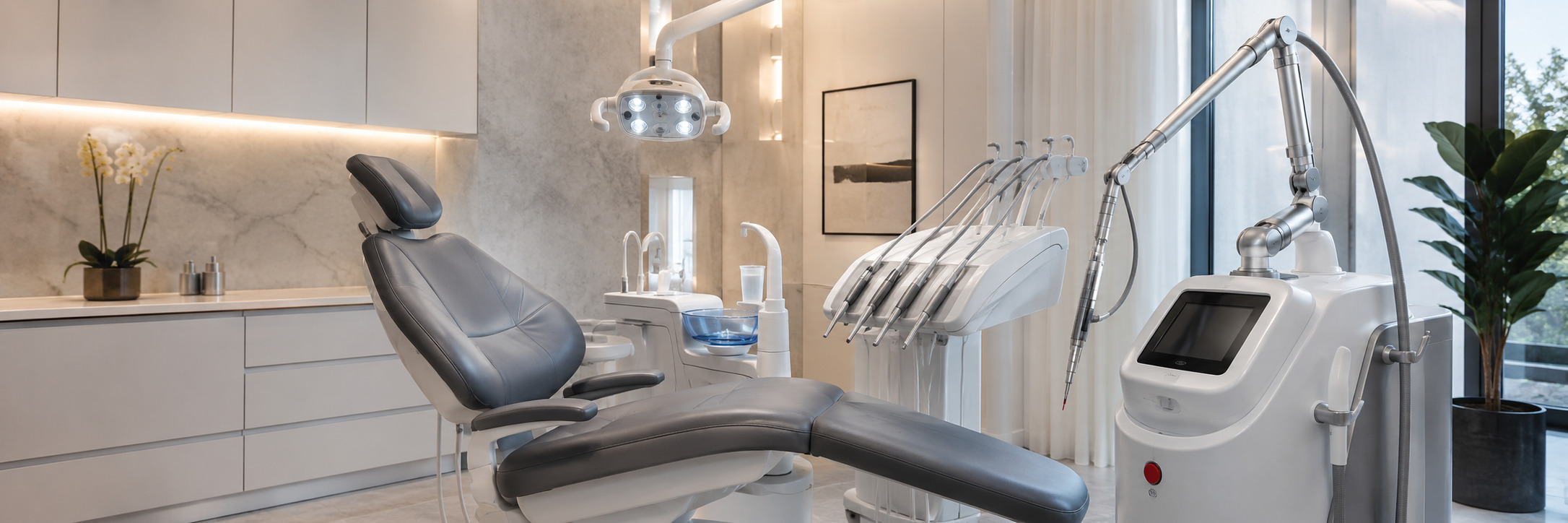
Laser dentistry uses concentrated light energy to carry out or support selected dental procedures. Depending on the laser system, wavelength and settings, a dentist may use it to treat certain soft tissues, remove selected areas of hard tissue, control bleeding or support bacterial reduction.
Dental lasers do not all work in the same way. Different wavelengths interact with different components of oral tissues, including water, pigment and mineral. This means a laser designed for gum treatment may not be suitable for treating a tooth, while a hard-tissue laser may have different applications and limitations.
Laser dentistry is not a replacement for every drill, scaler or surgical instrument. It is an additional clinical tool that may be useful when there is a clear reason to use it.
How Does Laser Dentistry Work? The Short Answer
A dental laser produces a concentrated beam of light at a specific wavelength. When that light reaches the treatment area, its energy is absorbed by particular components within the tissue.
Depending on the laser and its settings, the absorbed energy may allow the dentist to:
- Cut or reshape selected soft tissue
- Remove small amounts of hard tissue
- Control bleeding during some procedures
- Support bacterial reduction in selected treatments
- Deliver low-intensity light without cutting tissue
The result depends on the laser system, the tissue being treated, the diagnosis and the clinician’s technique. Lasers are often used alongside conventional dental instruments rather than instead of them.
What Is Laser Dentistry?
Laser dentistry is the use of specialised dental lasers to perform or assist with treatment in the mouth.
The word “laser” stands for light amplification by stimulated emission of radiation. In practical terms, the device produces a controlled beam of light rather than a conventional blade, drill or electrical instrument.
A dental laser is normally operated through a small handpiece. The dentist selects settings appropriate for the procedure and directs the light at a specific area.
The effect of the laser depends on:
- The wavelength of light
- The amount of energy delivered
- The pulse duration
- The type of tissue
- The amount of water, pigment or mineral in that tissue
- The distance and movement of the laser tip
This is why “laser dentistry” should not be treated as one single procedure. One laser cannot necessarily perform every type of dental treatment.
How Does Laser Light Interact With Oral Tissue?
Different dental tissues absorb light differently.
Soft tissues such as gums contain water and pigment. Certain laser wavelengths are readily absorbed by these components, allowing the dentist to remove or reshape tissue in a controlled way.
Teeth and bone contain more mineral. Hard-tissue laser systems are designed to interact with water and mineral within these structures. In selected cases, they can remove small areas of enamel, dentine or decay.
The laser must be matched correctly to the tissue. Incorrect settings or poor technique could cause unwanted heating or damage to healthy areas, which is why professional training and careful case selection are essential.
What Are the Main Types of Dental Lasers?
Dental lasers can be divided broadly according to their intended use.
Soft-tissue lasers
Soft-tissue lasers are primarily used on the gums and other non-mineralised tissues in the mouth.
Depending on the procedure, they may be used for:
- Gum contouring
- Removal of selected excess gum tissue
- Management of certain soft-tissue lesions
- Selected periodontal procedures
- Accessing or treating areas around the gum line
- Releasing selected soft-tissue attachments
During some soft-tissue treatments, a laser may help control bleeding as the tissue is treated. The extent of this effect depends on the laser and procedure.
Hard-tissue lasers
Hard-tissue lasers are designed to interact with teeth and, in selected circumstances, bone.
Possible applications may include:
- Removing small areas of tooth decay
- Preparing selected tooth surfaces
- Supporting certain treatments for dentine sensitivity
- Reshaping small areas of hard tissue
Hard-tissue lasers cannot replace a dental drill in every situation. Conventional instruments may still be required to remove existing fillings, manage deep decay, shape the preparation or complete the restoration.
Photobiomodulation
Photobiomodulation uses low-intensity light rather than using the laser to cut or remove tissue.
It has been studied as a possible way to influence inflammation, discomfort and tissue healing in selected situations. Its effectiveness depends on the condition being treated, the wavelength, dose and treatment protocol. Benefits are not guaranteed.
What Dental Treatments May Use Lasers?
Possible applications vary between practices and depend on the equipment available, the dentist’s training and the patient’s clinical needs.
Examples may include:
- Gum reshaping and contouring
- Removal of selected excess soft tissue
- Selected periodontal and gum treatments
- Supporting bacterial reduction during certain procedures
- Removing small areas of decay with suitable hard-tissue lasers
- Preparing selected tooth surfaces
- Supporting treatment for some forms of dentine sensitivity
- Managing selected mouth ulcers or soft-tissue lesions
- Assisting with certain root canal procedures
A laser may also be associated with some whitening systems, although teeth whitening is a separate cosmetic treatment that relies primarily on a bleaching product.
Not every practice provides every laser procedure listed above. A dentist should explain exactly which laser is being used and what role it has in the proposed treatment.
How Are Lasers Used in Gum Treatment?
Lasers may be used during selected soft-tissue and periodontal procedures. Their role depends on the diagnosis and type of gum problem.
Where gum disease is present, treatment may still require:
- Periodontal charting
- Removal of plaque and hardened calculus
- Scaling above and below the gum line
- Root surface cleaning
- Oral hygiene instruction
- Risk-factor management
- Regular periodontal maintenance
A laser may be used as an additional tool, but it does not remove every type of calculus and does not replace effective plaque control.
You can learn more about gum disease assessment and treatment on our periodontics page.
How Are Lasers Used During Root Canal Treatment?
Some laser systems may be used to support bacterial reduction during selected stages of root canal treatment.
However, a laser does not replace the main steps of cleaning, shaping, disinfecting and filling the root canal system. Conventional instruments, irrigating solutions and careful sealing remain important parts of treatment.
The suitability of laser-assisted root canal care depends on the tooth, canal anatomy and treatment protocol. Read more about root canal treatment at Glow Dental.
Does Laser Dentistry Replace the Dental Drill?
No. A laser may reduce the amount of drilling required in selected hard-tissue procedures, but it cannot replace a conventional dental drill in every case.
A drill or other instruments may still be needed when:
- Decay is deep or extensive
- An old filling must be removed
- A tooth requires a crown preparation
- The final shape needs to be refined
- The laser cannot safely access the treatment area
- The available laser is not suitable for hard tissue
Some procedures use a combination of laser technology and conventional instruments.
Does Laser Dentistry Sterilise the Treatment Area?
No dental procedure should be described as creating complete sterility inside the mouth.
Certain laser systems may support bacterial reduction during selected procedures, but the effect depends on the wavelength, settings, treatment area and clinical protocol.
Laser use does not remove the need for:
- Mechanical cleaning
- Appropriate disinfecting solutions
- Good oral hygiene
- Correct diagnosis
- Follow-up care
It is therefore more accurate to describe lasers as potentially supporting microbial reduction rather than fully disinfecting or sterilising tissue.
Is Laser Dentistry Safe?
Laser dentistry is generally considered safe when the treatment is clinically appropriate and carried out by a suitably trained dental professional using the correct laser and settings.
Safety measures may include:
- Protective eyewear for the patient and dental team
- Selection of the correct wavelength
- Appropriate power and pulse settings
- Protection of surrounding tissues
- Suitable suction and ventilation
- Careful control of the laser handpiece
Potential risks can include unwanted heat, damage to surrounding tissue, sensitivity, discomfort or delayed healing if the laser is used incorrectly.
A laser is not suitable for every patient, condition or procedure. The dentist should assess the benefits, limitations and available alternatives before recommending treatment.
Does Laser Dentistry Hurt?
Laser dentistry is not automatically pain-free. Comfort depends on the treatment, the tissue involved, the depth of the procedure and the patient’s individual sensitivity.
Some patients may prefer selected laser procedures because they can involve less vibration than conventional drilling. However, local anaesthetic may still be required.
During or after treatment, a patient may experience:
- Warmth or pressure
- Temporary tenderness
- Tooth sensitivity
- Gum soreness
- Mild swelling
The dentist should explain what level of discomfort is expected and whether anaesthetic is recommended.
Potential Advantages of Laser Dentistry
Depending on the treatment and laser system, potential advantages may include:
- Precise treatment of selected tissues
- Control of bleeding during some soft-tissue procedures
- Reduced use of conventional cutting instruments in selected cases
- Less vibration during some hard-tissue procedures
- Support for bacterial reduction as part of a wider treatment protocol
- An additional option when conventional methods are not the only suitable approach
These potential advantages do not apply to every laser or every procedure. They should not be interpreted as guaranteed outcomes.
What Are the Limitations of Laser Dentistry?
- One laser cannot perform every dental procedure.
- Laser treatment is not necessary for every patient.
- Conventional instruments may still be required.
- Local anaesthetic may still be needed.
- It is not guaranteed to be less painful.
- It is not automatically more effective than standard treatment.
- The treatment may cost more.
- Availability varies between practices.
- Results depend on diagnosis, equipment and clinician experience.
What Laser Dentistry Cannot Do
Laser dentistry cannot:
- Replace every dental drill or surgical instrument
- Guarantee pain-free treatment
- Remove the need for local anaesthetic in every case
- Cure gum disease without effective plaque control
- Sterilise the mouth completely
- Repair extensive tooth damage without appropriate restorative care
- Replace a correct diagnosis and treatment plan
- Guarantee faster healing or a better clinical result
The fact that a treatment uses newer technology does not automatically make it the best choice.
Does Laser Dentistry Work?
Dental lasers can be effective tools for selected procedures when the correct device, settings and technique are used.
The effectiveness of laser dentistry should be considered separately for each application. Results from one type of treatment or laser should not be assumed to apply to every other procedure.
For example, laser-assisted periodontal care may be useful in selected cases, but evidence does not consistently show a substantial advantage over conventional non-surgical gum treatment.
A dentist should explain:
- Why a laser is being recommended
- What the laser is expected to achieve
- Whether conventional instruments will also be required
- What alternatives are available
- What evidence supports its use in that procedure
Is Dental Laser Treatment Worth It?
Laser treatment may be worthwhile when the laser has a clear clinical role and offers a meaningful advantage for the proposed procedure.
Selected soft-tissue treatments may benefit from precise tissue removal and control of bleeding. Some patients may also prefer reduced vibration during suitable hard-tissue procedures.
However, laser treatment is not automatically less painful, faster-healing or more effective than conventional care.
Whether it is worthwhile depends on:
- The diagnosis
- The proposed procedure
- The type of laser
- The expected benefit
- The available alternatives
- The clinician’s experience
- The additional cost
You may also find our guide explaining whether laser-assisted teeth and gum cleaning is worth it helpful.
Who May Be Suitable for Laser Dentistry?
Laser treatment may be considered for patients who need selected:
- Soft-tissue procedures
- Gum contouring
- Periodontal treatment
- Hard-tissue treatment with an appropriate laser
- Supportive root canal procedures
- Treatments for specific soft-tissue conditions
Suitability depends on the patient’s oral health, the treatment required and the equipment available.
Patients with extensive decay, large restorations, heavily damaged teeth or complex treatment needs may still require conventional techniques.
What Happens During Laser Dental Treatment?
The exact process varies, but a laser appointment may include:
- An examination and diagnosis
- An explanation of the recommended treatment
- Discussion of conventional alternatives
- Local anaesthetic where required
- Protective eyewear
- Use of the laser with settings selected for the tissue
- Use of conventional instruments where necessary
- Aftercare instructions
The dentist should tell you what sensations to expect, how long the procedure may take and what recovery may involve.
Questions to Ask Before Laser Treatment
- What is my exact diagnosis?
- What type of laser will be used?
- What is the laser intended to achieve?
- Will conventional instruments also be needed?
- What are the alternatives?
- What additional benefit is expected?
- Will I need local anaesthetic?
- What are the possible risks?
- What should I expect after treatment?
- What is included in the cost?
Why Choose Glow Dental for Laser Dentistry?
At Glow Dental, technology is used where it provides an appropriate clinical option rather than simply because it is available.
We offer laser dentistry alongside conventional dental and periodontal care. Before recommending treatment, we assess the condition of your teeth, gums and surrounding tissues and explain the expected role of the laser.
Where a laser is not necessary, we can discuss other suitable treatment options.
Book a Laser Dentistry Assessment at Glow Dental
Whether laser dentistry is suitable depends on the condition being treated and the clinical benefit expected.
Glow Dental provides laser dentistry and conventional dental care at our practice on Northcote Road in Battersea, close to Clapham Junction. We welcome patients from Battersea, Clapham, Wandsworth, Chelsea and surrounding areas of South West London.
Following an assessment, we can explain whether a laser may be appropriate, which alternatives are available and what the procedure may involve.
Written by:
Glow Dental
Published:
Last updated: