
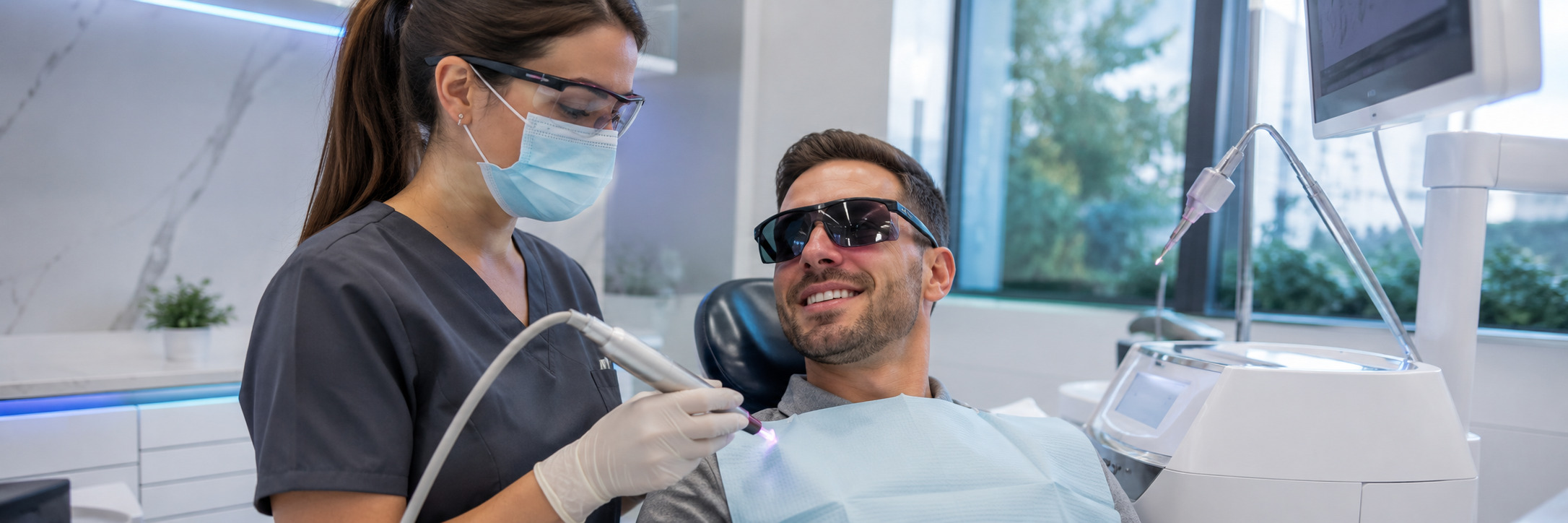
The phrase “laser teeth cleaning” can be misleading because it is not the name of one standard dental procedure. It usually refers to the use of a dental laser alongside conventional cleaning or periodontal treatment.
Laser-assisted treatment may be worthwhile for selected patients with gum disease, inflamed gum tissue or persistent periodontal pockets. However, it is not necessary for everyone and does not replace the physical removal of plaque and hardened calculus.
For patients with healthy teeth and gums, a routine dental hygiene appointment may be all that is required. Where gum disease is present, the most appropriate treatment depends on the diagnosis, pocket depths, bone support, oral hygiene and response to initial periodontal care.
Is Laser Teeth Cleaning Worth It? The Short Answer
Laser-assisted gum treatment may be worth considering when there is a clear clinical reason to use it. It can provide an additional treatment option for selected soft-tissue and periodontal procedures.
However, laser treatment is not automatically better than conventional care. It does not remove all hard calculus by itself and will usually need to be combined with scaling, root surface cleaning and effective plaque control.
Current evidence does not consistently show that laser-assisted periodontal treatment produces substantially better results than conventional non-surgical gum treatment alone. Its value depends on the diagnosis, the laser system, the treatment protocol, the clinician’s experience, the cost and the patient’s individual needs.
What Does “Laser Teeth Cleaning” Actually Mean?
Patients may use the term “laser teeth cleaning” to describe several different procedures, including:
- Laser-assisted treatment of gum inflammation
- Laser treatment within periodontal pockets
- Removal or reshaping of selected soft tissue
- A conventional dental clean that includes an additional laser stage
- Laser-assisted periodontal surgery
It is therefore important to ask exactly what treatment is being recommended and what the laser is intended to achieve.
Laser-assisted gum treatment should not be confused with teeth whitening. Whitening uses a bleaching product to change the colour of the teeth and is a separate cosmetic procedure.
What Is Laser-Assisted Periodontal Treatment?
Laser-assisted periodontal treatment involves using concentrated light energy during the management of gum disease or soft-tissue problems.
Depending on the laser system and the treatment required, it may be used to:
- Treat selected inflamed soft-tissue areas
- Remove diseased or excess gum tissue
- Access selected areas within periodontal pockets
- Support bacterial reduction as part of a wider treatment protocol
- Control bleeding during some soft-tissue procedures
The laser is usually an additional clinical tool. It does not replace a full diagnosis, periodontal charting, mechanical cleaning or long-term maintenance.
How Does Laser-Assisted Gum Treatment Work?
The exact procedure varies according to the condition being treated and the type of laser used.
Where gum disease is present, treatment may begin with:
- An examination of the teeth and gums
- Measurement of periodontal pocket depths
- Assessment of bleeding and gum inflammation
- X-rays when clinically required
- Oral hygiene instruction
- Mechanical removal of plaque and calculus
Traditional instruments or ultrasonic equipment may be used to remove deposits from above and below the gum line. A laser may then be used in selected areas as part of the periodontal treatment plan.
The settings and technique must be appropriate for the tissue being treated. Different laser systems behave differently, which is one reason why the results of “laser dentistry” cannot be treated as identical across every procedure.
Does Laser Treatment Replace Scaling and Root Planing?
No. Laser treatment does not normally replace scaling and root planing or other forms of mechanical periodontal cleaning.
Hardened calculus attached to the teeth and root surfaces must still be physically removed. A laser may be used as an adjunct, but it cannot be relied upon to remove every type of deposit from the teeth.
For patients with periodontitis, conventional non-surgical treatment may include:
- Detailed oral hygiene instruction
- Scaling above and below the gum line
- Root surface cleaning
- Management of risk factors such as smoking
- Reassessment of the gums after healing
- Ongoing periodontal maintenance
Learn more about the assessment and management of gum disease on our periodontics page.
Is Laser Treatment Better Than Conventional Gum Treatment?
Not necessarily. For many patients, conventional scaling and periodontal care provide an appropriate and effective treatment approach.
Laser-assisted treatment may be considered in selected cases, but its use does not guarantee:
- Better long-term results
- Faster healing
- Complete removal of periodontal bacteria
- Elimination of gum pockets
- A painless procedure
- Freedom from future maintenance
Research comparing laser treatment with scaling and root planing has not consistently demonstrated a substantial additional clinical benefit. A newer or more expensive technology is not automatically the most suitable treatment for every patient.
Potential Benefits of Laser-Assisted Gum Treatment
Depending on the diagnosis and procedure, potential advantages may include:
- Precise treatment of selected soft-tissue areas
- Control of bleeding during some procedures
- Reduced need for conventional cutting instruments in selected treatments
- An additional option for managing inflamed or diseased gum tissue
- Possible bacterial reduction within a wider periodontal treatment plan
These benefits are not guaranteed. The outcome depends on the condition being treated, the laser technology, the treatment protocol and the clinician’s experience.
What Are the Limitations?
Laser-assisted treatment also has important limitations:
- It is not required for every patient.
- It does not remove all hard calculus by itself.
- It does not replace scaling and root surface cleaning.
- It may cost more than conventional treatment.
- Not every laser is appropriate for every procedure.
- The evidence for additional clinical benefit is mixed.
- Local anaesthetic may still be required.
- Temporary tenderness or sensitivity may still occur.
- Long-term results still depend heavily on oral hygiene and maintenance.
What Laser Treatment Cannot Do
Laser treatment cannot:
- Cure gum disease without effective plaque control
- Reverse all bone loss caused by periodontitis
- Remove every type of plaque and calculus without mechanical cleaning
- Guarantee that periodontal pockets will disappear
- Prevent gum disease from returning
- Replace regular dental examinations
- Replace periodontal maintenance appointments
- Compensate for smoking or poor oral hygiene
Successful periodontal care normally requires a combination of professional treatment, effective home cleaning, risk-factor management and regular review.
Who May Be Considered for Laser-Assisted Treatment?
A dentist or periodontist may consider laser-assisted treatment for selected patients with:
- Diagnosed gum disease
- Inflamed or bleeding gum tissue
- Periodontal pockets requiring professional treatment
- Soft-tissue areas requiring precise treatment
- Specific periodontal or surgical needs
Where inflammation or deeper periodontal pockets remain after initial care, further assessment is required. The next step may involve additional non-surgical cleaning, specialist periodontal treatment, surgery or, in selected cases, a laser-assisted procedure.
Patients with healthy gums who only require removal of plaque, calculus and surface stains are unlikely to need laser-assisted periodontal treatment.
Is Laser Teeth Cleaning Painful?
Comfort depends on the type and extent of treatment rather than simply on whether a laser is used.
Some soft-tissue procedures may involve less bleeding or a different sensation from conventional treatment. However, treatment within inflamed or deep periodontal pockets can still cause discomfort, and local anaesthetic may be required.
After treatment, temporary symptoms may include:
- Gum tenderness
- Mild sensitivity
- Temporary bleeding
- Discomfort when brushing the treated area
Contact the practice if pain becomes severe, swelling increases or symptoms do not improve as expected.
Will I Need More Than One Laser Treatment?
There is no standard schedule that applies to every patient. The number of appointments depends on:
- The periodontal diagnosis
- The number and depth of gum pockets
- The areas requiring treatment
- The patient’s response to initial care
- The type of laser procedure
- The need for further periodontal treatment
Long-term gum health usually depends more on effective plaque control, appropriate mechanical cleaning and regular periodontal maintenance than on repeating laser treatment at fixed intervals.
When May Laser-Assisted Treatment Be Worth It?
Laser-assisted treatment may be worthwhile when:
- There is a specific clinical reason for using it
- The expected role of the laser is clearly explained
- It forms part of a complete periodontal treatment plan
- Conventional cleaning is also provided when required
- The potential benefits justify the additional cost
- The patient understands the limitations and alternatives
It may be less worthwhile when:
- The gums are healthy
- The patient only needs routine plaque and calculus removal
- The laser is presented as a guaranteed cure
- The provider claims it completely replaces scaling
- The additional cost is not supported by a clear clinical benefit
Questions to Ask Before Laser Treatment
Before agreeing to treatment, ask:
- What is my exact diagnosis?
- What does the laser do in my treatment plan?
- Will scaling or root surface cleaning also be required?
- What are the alternatives?
- What additional benefit is expected in my case?
- What evidence supports the recommended procedure?
- Will I need local anaesthetic?
- How many appointments are expected?
- What are the possible risks and side effects?
- What is included in the quoted cost?
- What maintenance will be required afterwards?
How to Maintain Gum Health After Treatment
Laser-assisted care cannot prevent plaque from returning. Daily cleaning and professional maintenance remain essential.
- Brush twice daily with fluoride toothpaste.
- Clean between the teeth every day using suitable interdental brushes or floss.
- Follow the personalised cleaning advice provided by your dental professional.
- Attend recommended dental and hygiene appointments.
- Attend periodontal maintenance visits where advised.
- Avoid smoking.
- Manage health conditions that may affect the gums.
- Contact the practice if bleeding, swelling or discomfort returns.
Why Choose Glow Dental for Laser Dentistry?
At Glow Dental, recommendations are based on the condition of your teeth and gums rather than on using technology for its own sake.
We offer laser dentistry alongside conventional dental and periodontal care. Before recommending treatment, we assess your gum health, pocket depths, oral hygiene and relevant risk factors.
Where laser treatment is not necessary, we can explain whether routine hygiene care, deeper periodontal cleaning or specialist periodontal treatment would be more appropriate.
Book a Gum Health Assessment at Glow Dental
The best way to determine whether laser-assisted treatment is suitable is to have your teeth and gums properly assessed.
Glow Dental provides gum health assessments, periodontal care and laser dentistry at our practice on Northcote Road in Battersea, close to Clapham Junction. We welcome patients from Battersea, Clapham, Wandsworth, Chelsea and surrounding areas of South West London.
Following your examination, we can explain whether routine hygiene care, non-surgical gum treatment, specialist periodontics or a laser-assisted procedure may be appropriate.
Written by:
Glow Dental
Published:
Last updated: